What Is an AI Visibility API?
Search is splitting in two. People still open Google and type a query. But a growing chunk of the same people now open ChatGPT, Claude, Gemini, or Perplexity and ask a question in plain language, then act on whatever answer comes back.
For years the only question that mattered for a brand was "do we rank?" That question is still real. Google is not going away. But there is a second question sitting right next to it now: "do the models mention us?" When someone asks Claude for the best project management tool for a small agency, your name is either in that answer or it is not. There is no page two to scroll to.
Most teams have no idea what those answers say about them. They can pull their Google rankings in ten seconds and have zero visibility into what four AI models tell millions of people every day. That gap is what an AI visibility API is built to close.
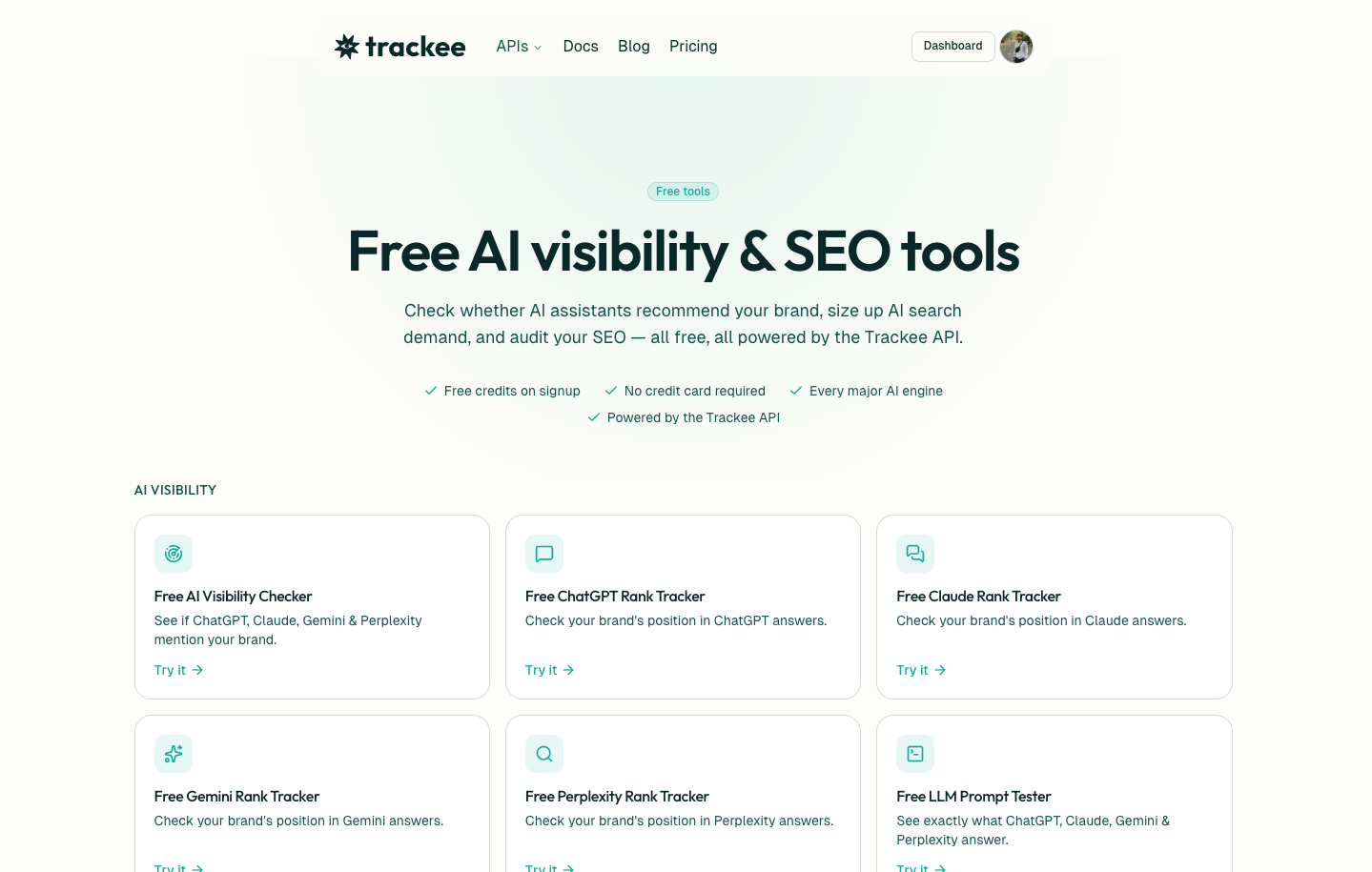
If you just want to see where you stand right now, the free AI visibility checker runs a prompt across the models in your browser, no code and no signup. Good way to feel the problem before you read the rest of this.
What AI visibility means
AI visibility is whether your brand shows up when someone asks an AI model a question you care about. Three things happen inside an answer, and they are not the same:
- Mentioned. The model names your brand at all.
- Ranked. The model lists you first, third, or seventh among the options it gives.
- Cited. The model links to your site as a source for its claim.
You can be mentioned without being cited, ranked well without being linked, or cited as a source while a competitor gets the top recommendation. Each of those is a different outcome and each one needs its own measurement.
Alongside the AI answers, the classic layer still exists. Google's ten blue links, plus the AI Overview block that now sits above them and summarizes an answer before anyone clicks. So the full picture is Google organic rankings, the AI Overview, and the four big chat models, all at once.
Two acronyms describe the work of showing up in this new layer. AEO is answer engine optimization, getting your brand into the direct answers that engines return instead of a list of links. GEO is generative engine optimization, shaping how generative models describe and recommend you. Same goal from two angles: be the thing the machine says when someone asks.
Why it is hard to measure yourself
The obvious move is to check it yourself. Open ChatGPT, ask the question, see if you show up. That works exactly once and then falls apart.
The engines disagree. Ask the same question to ChatGPT, Claude, Gemini, and Perplexity and you get four different answers with four different brands on top. Measuring one tells you almost nothing about the other three.
The answers move. Run the same prompt twice and the wording shifts, the order changes, and a brand that was mentioned last week is gone this week. A single manual check is a snapshot of one moment, and the moment has already passed by the time you read it.
Then there is the plumbing. To do this properly you need to hit four model APIs, parse loose natural-language answers into structured data, scrape Google for rankings and the AI Overview, handle rate limits, rotate through captchas, and keep all of it running when any one provider changes its output format next month. That is not a script. That is a maintenance project that quietly eats an engineer, and it produces data as a side effect of staying alive.
The point of building a product is not to also run a scraping and LLM-parsing operation on the side. That is the part you want to hand off.
What an AI visibility API gives you
An AI visibility API takes the messy work and hands you clean JSON. You send a brand and a prompt, it runs the check across engines, and it gives you back structured results you can store, chart, and act on.
The useful fields are the ones that answer a real question. Were we mentioned. What position. What sources did the model cite. Which competitors showed up next to us. What is our share of voice against them. And because it is an API and not a one-off check, you get history, so you can see the number move over time instead of guessing.
Here is the shape of a small visibility result:
{
  "brand": "Trackee",
  "prompt": "best seo api for tracking ai search visibility",
  "mentioned_in": 3,
  "engines_checked": 4,
  "results": [
    { "engine": "chatgpt", "mentioned": true, "position": 2 },
    { "engine": "claude", "mentioned": true, "position": 1 },
    { "engine": "perplexity", "mentioned": true, "position": 4 },
    { "engine": "gemini", "mentioned": false, "position": null }
  ]
}
That is the difference between a vague feeling and a number. Mentioned in three of four engines, top ranked in one, missing from Gemini. Now you know exactly where the work is.
The Trackee endpoints
Trackee splits the surface into a handful of focused endpoints, so you pull only the piece you need and compose the rest.
- AI visibility runs a prompt across ChatGPT, Claude, Gemini, and Perplexity and reports whether your brand is mentioned, where it ranks, and what got cited. This is the core of the AEO and GEO picture.
- Google rank and AI Overviews checks classic organic position for a keyword and pulls the AI Overview block, so you see both the old ranking and the new summary in one call.
- Keyword research finds the terms and questions worth tracking in the first place, so you point the visibility checks at prompts people actually ask.
- Brand mentions tracks where your name appears across results and answers, beyond a single keyword, so you catch mentions you never optimized for.
- SERP competitors returns who else is ranking and showing up for the same queries, which is how you calculate share of voice instead of looking at yourself in isolation.
- Brand tracking ties it together over time, saving brands and prompts so you watch presence trend instead of pulling one number and forgetting it.
Each endpoint returns plain JSON. You can wire one into a dashboard, feed several into a report, or build a whole AEO product on top of the set.
Three ways to use it
You can reach the same data three ways, depending on what you are building.
The REST API is the direct route. Call an endpoint, get JSON, do what you want with it. This is what you build products and internal tools on.
The MCP server for AI agents exposes the same checks as tools an AI agent can call on its own. Point Claude or another agent at it and it can look up a brand's visibility mid-conversation, no glue code required. Ask it "is my brand showing up in ChatGPT for this prompt" in plain language and it pulls the numbers back. The MCP setup docs walk through wiring it up.
The dashboard is for the people who want to see the numbers without writing a request. Save a brand, add prompts, read the charts. This is also how agencies run it, one place to track many client brands side by side without touching the API.
Where this is going
A single check is interesting. The real value shows up when you run checks on a schedule and watch the line move.
Save the brands and prompts you care about. Run them daily or weekly. Track share of voice as it shifts, catch the week a competitor overtakes you in three of four models, and see whether a content change actually moved your position in the AI answers. That is monitoring, and it is the difference between reacting to a surprise and seeing it coming.
The reason to start measuring now is simple. The AI answer layer is early, positions are still soft, and the brands that understand where they stand can do something about it. The ones who wait will be optimizing blind against competitors who already have the data.
Get started
The free plan is enough to run your first visibility checks and see where your brand stands across Google and the four big models. If you want the fuller picture on watching presence over time, tracking AI search visibility covers the monitoring side. When you are ready to build, the API reference has every endpoint, field, and example. Measure first, then go fix what the numbers show you.